 Skip to content








































Conduction, Convection, Radiation: How Solar Panels Shed Excess Heat

On a sunny summer afternoon, a rooftop solar panel can reach surface temperatures of 65–80 °C — hot enough to cause a minor burn on contact. Yet the panel keeps working. That's because the same physics that governs every hot object on Earth is quietly at work, constantly pulling heat away from the silicon and back into the environment. Three mechanisms are responsible: conduction, convection, and radiation. Understanding how they interact explains not just why panels get hot, but what can be done to keep them cool — and which panel technologies handle heat better than others.
Why panels generate heat in the first place
A solar cell converts sunlight into electricity through the photovoltaic effect, but it cannot convert all incoming light. Photons with too little energy pass straight through. Photons with too much energy release their excess energy as vibrations in the crystal lattice, which is just another way of saying heat. Depending on the cell technology, roughly 15–25% of the solar energy that strikes the panel is converted into electricity; the rest, between 75 and 85%, is converted into thermal energy trapped in the module.
That heat has to go somewhere. The three pathways below are how it escapes.
Conduction: heat moving through a solid material
Conduction is the transfer of heat through direct physical contact between materials. Inside a solar panel, heat generated in the silicon cells passes first into the encapsulant (typically EVA, ethylene-vinyl acetate), then through the glass front sheet or rearward into the backsheet. The backsheet's thermal conductivity matters enormously: white backsheets are more thermally conductive than black ones and can reduce operating temperature by several degrees, while a thermally insulating backsheet acts like a lid on a pot — trapping heat inside the module.
When a panel is roof-mounted with a narrow air gap, conduction also carries heat into the mounting rails and, to a lesser extent, into the roof structure below. Because the roof is typically warmer than ambient air, this pathway is largely ineffective as a cooling route — which is exactly why ventilation gaps exist.
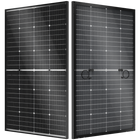
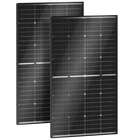
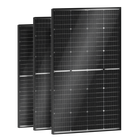
Panel design matters here. Rigid panels like BougeRV TOPCon 200W rigid solar panel use a reinforced aluminum frame and high-transmittance tempered glass, both of which conduct surface heat into the frame perimeter and dissipate it efficiently — a design advantage over frameless or adhesive-mounted panels in fixed installations.

Convection: heat carried away by moving air
Convection is the dominant cooling mechanism for most rooftop and ground-mounted installations. It works in two forms.
Natural convection occurs when air in contact with the warm backsheet heats up, becomes less dense, and rises — drawing cooler air in from the sides. Forced convection happens when wind blows across the panel surface, continuously sweeping away the warm boundary layer and replacing it with cooler ambient air.
The air gap between a roof-mounted panel and the roofing surface is critical. A gap of at least 10 cm (about 4 inches) allows a proper chimney effect: cool air enters at the bottom of the array, heats as it passes under the panels, and exits at the top. Reduce that gap to 2–3 cm, and airflow nearly stalls, cutting convective cooling by more than half.
Wind plays a starring role. Studies have measured panel temperature reductions of roughly 1 °C per 1 m/s increase in wind speed. On a breezy day with winds of 5–7 m/s, convective cooling alone can keep a panel 20 °C cooler than it would be in still air.
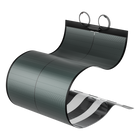
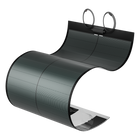
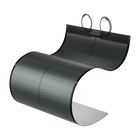
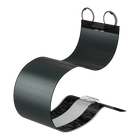
Flexible vs. rigid mounting and convection. BougeRV Yuma CIGS flexible solar panels and the TOPCon Arch Pro flexible panels can be adhered directly to curved RV or boat surfaces, which limits the air gap and reduces convective cooling. This is a deliberate trade-off accepted for portability and low-profile mounting. For fixed rooftop installations where maximum efficiency is the goal, BougeRV rigid TOPCon panels, mounted on standoff brackets, preserve the air gap and enable full convective cooling. (Use the discount code "SEOBF" at checkout to enjoy an additional 6% off for BougeRV solar panels.)
Radiation: heat emitted as infrared light
Every warm object emits thermal radiation — electromagnetic waves in the infrared spectrum. This is the same process by which the sun heats the Earth, just at much lower temperatures and longer wavelengths. A solar panel at 70 °C radiates infrared energy continuously in all directions: upward into the sky, downward toward the roof, and sideways into the surrounding environment.
The efficiency of this process depends on emissivity, a material property ranging from 0 (perfect mirror, radiates nothing) to 1 (perfect blackbody, radiates maximally). The glass front surface of a typical panel has an emissivity of about 0.85–0.90, making it a reasonably good radiator. The backsheet's emissivity varies by product, which is why some manufacturers now specify it alongside thermal conductivity.
Radiative cooling is especially effective at night and on clear, dry days when the sky is relatively "cold" (low in downwelling longwave radiation). On humid days or under heavy cloud cover, the sky itself radiates back toward the panel, partially cancelling the outgoing heat flux.
How the three mechanisms compare
At typical operating conditions (panel at 55–65 °C, moderate wind, clear sky), convection accounts for roughly 60–70% of total heat loss, radiation for 25–35%, and conduction to the mounting structure for a comparatively small share — often under 10%. These proportions shift with conditions: in still air, radiation's share grows; at high wind speeds, convection dominates even more strongly.
|
Mechanism |
Typical share of heat loss |
Key variables |
|
Convection |
60–70% |
Wind speed, air gap, mounting height |
|
Radiation |
25–35% |
Surface emissivity, sky temperature |
|
Conduction |
5–10% |
Frame material, mounting contact area |

Why cell technology affects thermal performance
Not all panels respond to heat the same way. The most important spec to compare is the temperature coefficient of power (Pmax) — the percentage of rated output lost for every 1 °C rise above the standard test temperature of 25 °C.
- Conventional P-type PERC cells: typically −0.35% to −0.45%/°C
- N-type TOPCon cells: typically −0.28% to −0.32%/°C
- HJT cells: typically −0.24%/°C
TOPCon solar panels are known for their high efficiency and improved temperature coefficients, performing better at high temperatures compared to P-type cells, PERC, and HJT technologies. The reason lies in the cell structure: an ultra-thin tunneling oxide layer between the n-type silicon substrate and a doped polysilicon layer reduces electron recombination — including the thermally activated recombination that intensifies as temperature rises.
BougeRVN-type TOPCon ShadePower 200W rigid panel carries a temperature coefficient of −0.32%/°C, meaning it loses less output per degree of temperature rise than standard PERC equivalents. On a hot summer day where a panel reaches 65 °C (40 °C above STC), a PERC panel at −0.40%/°C loses 16% of rated output, while a TOPCon panel at −0.32%/°C loses only 12.8% — a meaningful difference that compounds over years of hot-climate operation.
Recommended for hot climates: BougeRV N-type TOPCon rigid solar panels — including the 200W ShadePower and the TOPCon Arch Pro flexible series — combine a lower temperature coefficient with anti-hotspot protection, making them well-suited to high-temperature environments like desert Southwest installations, RV rooftops in summer, and boat decks in tropical waters.
What this means in practice
The three mechanisms are not independent levers. Improving convection (by raising mounting height to open the air gap) also reduces panel temperature, which in turn reduces radiation losses — because a cooler surface radiates less total energy. Choosing a backsheet with high emissivity boosts radiative cooling from the rear surface, while a thermally conductive frame transfers heat to the air more quickly through conduction.
For a typical 200 W panel on a hot, still day, the difference between a well-ventilated and a poorly ventilated installation can amount to 10–15 °C in operating temperature. At a temperature coefficient of −0.32%/°C (as found on BougeRV's TOPCon panels), that translates to a 3.2–4.8% output difference — a meaningful loss compounding over a 25-year panel life.
The physics is straightforward. The engineering challenge is to keep all three pathways as open as possible, so that the heat that cannot be converted to electricity leaves the module as quickly as it arrives.
FAQ
Q1: Does a hotter panel produce less electricity?
Yes. Every silicon-based solar panel has a negative temperature coefficient: as the cell temperature rises above 25 °C (the standard test condition), output voltage drops and power decreases. The exact rate depends on cell technology. A conventional PERC panel might lose 0.40% of its rated power per degree Celsius, while an N-type TOPCon panel loses only 0.32%/°C. Over a hot summer day, this difference can add up to several percentage points of real-world output.
Q2: Why do flexible solar panels sometimes run hotter than rigid ones?
Flexible panels, particularly those adhered directly to an RV roof or boat deck with minimal air gap, lose the convective cooling that rigid rack-mounted panels enjoy. Without airflow beneath the panel, the only meaningful heat dissipation paths are radiation from the top surface and conduction into the substrate below. This can raise operating temperatures by 10–20 °C compared to rack-mounted rigid panels.
Q3: Does wind speed significantly affect solar panel output?
Indirectly, yes. Wind itself doesn't generate electricity from a solar panel, but it dramatically improves convective cooling. Research has consistently shown that panels in higher wind environments run cooler and therefore produce more power. A panel cooled from 65 °C to 50 °C by a 5 m/s breeze recovers roughly 4–6% of its rated output (depending on temperature coefficient). This is one reason ground-mounted arrays in open fields often outperform identical roof arrays in summer: better all-around airflow keeps cells closer to their rated temperature.
Q4: Is there anything I can do to keep my existing panels cooler?
Several practical steps help. First, ensure adequate mounting clearance — at least 10 cm of air gap beneath roof-mounted panels. Second, keep the backsheet clean; a layer of dust and grime acts as insulation and raises operating temperature. Third, consider the time of day: panels cool down quickly after sunset, and morning output in summer is typically stronger than afternoon output because ambient temperatures are lower.


